If your garage door opens and closes four times a day, your springs are essentially ticking toward a predetermined expiration date with every single click of the remote. Most homeowners eventually find themselves asking how long do garage door springs last only after a loud bang echoes through the garage or the door refuses to budge. It’s stressful to wonder if your heavy door might suddenly crash down or if you’ll be stuck with a massive repair bill. You deserve a home that functions reliably, and we’re here to provide the technical clarity you need to lower that stress.
You can accurately predict the lifespan of your hardware by looking at your household’s specific usage cycles and local environmental factors. This 2026 guide will help you discover the exact durability of your springs, the factors that cause them to snap, and how to extend their life to avoid costly emergency repairs. We’ll explore the mechanical differences between torsion and extension systems, identify the specific rust-prone conditions that shorten their life in Washington, and provide actionable maintenance steps to keep your system running safely.
Key Takeaways
- Understand why hardware lifespan is measured in cycles rather than years, allowing you to calculate exactly how long do garage door springs last based on your family’s daily habits.
- Compare the mechanical advantages of torsion versus extension systems to identify which spring type provides the best long-term durability and safety for your home.
- Pinpoint the specific environmental factors in Washington, including coastal humidity and Eastern temperature shifts, that can cause springs to rust or snap prematurely.
- Learn to spot the primary indicators of imminent spring failure, such as visible gaps in the metal coils or the unmistakable sound of a high-tension break.
- Discover a simple semi-annual maintenance routine that prevents corrosion and ensures your garage door operates reliably without the need for emergency repairs.
Understanding Garage Door Spring Lifespan: Cycles vs. Years
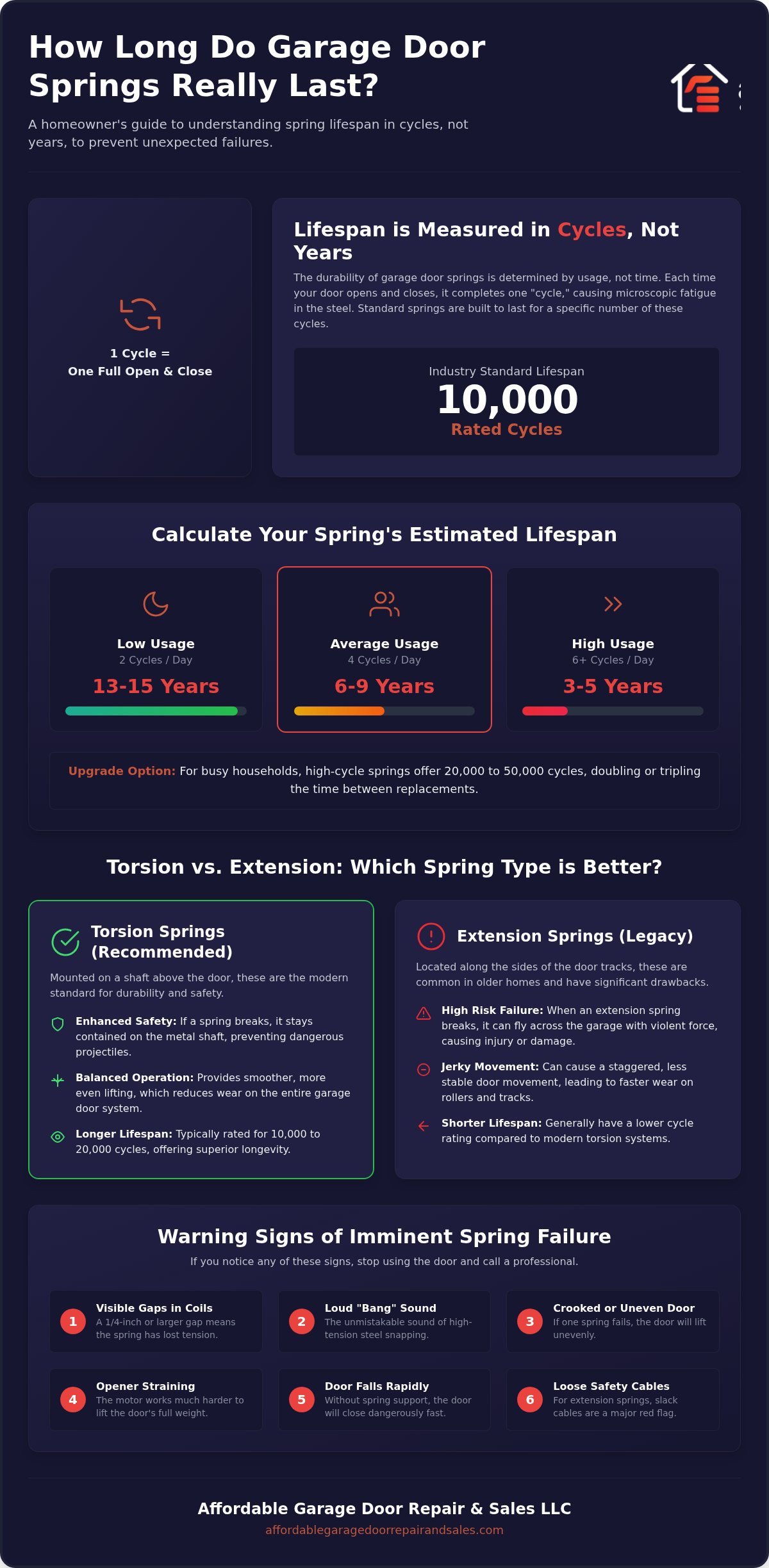
Determining how long do garage door springs last requires looking past the calendar on your wall. While most homeowners think in terms of years, manufacturers and technicians measure hardware life in “cycles.” A single cycle represents the door traveling from a fully closed position to fully open and then back down again. This distinction is vital because a door that stays closed for months doesn’t age the same way as one that operates hourly. When you’re planning your home maintenance budget, knowing exactly how long do garage door springs last helps you avoid the stress of a sudden vehicle entrapment.
Most standard residential doors come equipped with springs rated for 10,000 cycles. This industry benchmark is designed to provide a balance between manufacturing costs and reliable performance for the average user. If you use your garage as the primary entrance to your home, those cycles disappear faster than you might expect. It isn’t just about the age of the home; it’s about the mechanical workload the steel has endured.
The Math Behind the Metal
Estimating your hardware’s lifespan is a simple matter of division. Take the 10,000-cycle rating and divide it by your daily usage. For a household that opens the door four times a day, the math looks like this: 10,000 cycles / (4 cycles per day * 365 days) = approximately 6.8 years. If your family uses the garage as the main hub for bikes, lawn equipment, and multiple vehicles, your daily count might be much higher.
- Low usage (2 cycles/day): Expect 13 to 15 years of service.
- Average usage (4 cycles/day): Expect 6 to 9 years of service.
- High usage (6+ cycles/day): Expect failure in 3 to 5 years.
For those living in busy households, a high-cycle spring is a specialized component rated for 20,000 to 50,000 cycles. These provide a durable solution for Washington homeowners who want to double or even triple their maintenance intervals.
Why Years Can Be Deceiving
Chronological age is often a poor predictor of when a snap will occur. A 15-year-old spring on a detached guest garage that only sees use once a week is likely in better mechanical shape than a 3-year-old spring on a main door. This is because Garage door springs operate under immense tension, and every use causes microscopic fatigue in the steel. This fatigue is a cumulative process where the metal coils stretch or twist, slightly altering the molecular structure of the metal each time.
Eventually, the metal reaches its limit and can no longer support the weight of the door. Over-cycling is the leading cause of unexpected morning breakdowns. Because metal is most brittle when cold, springs frequently snap during the first operation of a chilly morning. This often leaves your car trapped inside when you’re already running late for work. Understanding this mechanical age helps you plan for a professional inspection before the metal reaches its breaking point.
Torsion vs. Extension Springs: Which Lasts Longer?
The specific hardware configuration of your door plays a massive role in how long do garage door springs last. Most residential systems utilize either torsion springs or extension springs. Torsion springs are mounted on a metal shaft directly above the door opening. In contrast, extension springs are located along the upper horizontal tracks on either side of the door. While both serve the same fundamental purpose of counterbalancing the door’s weight, their mechanical design leads to significantly different lifespans and safety profiles.
The Superiority of Torsion Springs
Torsion springs are widely considered the industry gold standard for durability. These springs operate by twisting and untwisting to provide torque, which distributes the door’s weight more evenly across the entire system. Because of this balanced distribution, torsion springs typically offer a lifespan of 10,000 to 20,000 cycles. This enhanced reliability is why most modern new garage door installations in Washington prioritize torsion systems over older alternatives.
Safety is a primary advantage of the torsion design. If a torsion spring snaps, it remains coiled around the central metal shaft. This prevents the spring from flying off and causing injury or property damage. The shaft also helps prevent the door from crashing down instantly, providing a more stable failure mode. This level of precision and safety is a hallmark of high-quality garage door engineering that provides long-term peace of mind for homeowners.
The Vulnerabilities of Extension Springs
Extension springs are often found in older homes or on lighter, budget-friendly doors. These springs function by stretching and contracting as the door moves. This linear tension makes them more prone to uneven wear, which often results in “jerking” movements during operation. Due to the constant physical stretching of the metal, extension springs have a shorter lifespan, typically ranging from 5,000 to 10,000 cycles. This reduced durability is a key factor when calculating how long do garage door springs last for your specific setup.
The physical danger of extension springs is higher because they lack a central shaft to contain them during a break. Without properly installed safety cables, a snapping extension spring can become a dangerous projectile. Adhering to CPSC garage door safety rules is essential to ensure these cables are in place to catch the spring. Many homeowners choose to convert their system to a torsion setup during a professional spring repair to benefit from the increased longevity and superior safety features of modern torsion hardware.
Factors That Shorten Spring Life in Washington State
While cycle counts provide a mathematical baseline, the unique climate of the Pacific Northwest often dictates how long do garage door springs last in practice. Washington homeowners face environmental challenges that can accelerate metal fatigue and corrosion far beyond standard expectations. Understanding these local variables allows you to take proactive steps to protect your hardware before a failure occurs. The combination of humidity, temperature shifts, and door weight creates a demanding environment for high-tension steel.
Rust: The Pacific Northwest’s Silent Spring Killer
Moisture is the primary enemy of high-tension steel. In coastal areas or the humid corridors of Western Washington, surface rust quickly develops between the tightly wound coils. This oxidation creates excessive friction every time the spring twists. Over time, this friction leads to “pitting,” which describes small divots that form in the metal. These divots act as stress concentrators, creating weak points that eventually snap under pressure. We recommend applying a high-quality silicone-based lubricant every three months to create a moisture barrier that is specifically designed for PNW weather.
Temperature Fluctuations in Eastern Washington
Residents in Spokane and Yakima deal with a different set of technical challenges. Extreme temperature shifts cause the metal to expand and contract repeatedly. This constant movement at a molecular level accelerates metal fatigue. When temperatures drop below freezing, the steel becomes more brittle and less resilient. This is why many homeowners discover a broken spring on the coldest morning of the year when the metal is at its most vulnerable state.
Improper Door Balance and Weight
The weight of your door must be perfectly counterbalanced by the spring’s tension. If your door is out of balance, the springs are forced to lift more weight than they were engineered to handle. This extra strain significantly reduces how long do garage door springs last. Several factors can disrupt this delicate balance:
- Adding aftermarket insulation panels that increase the total door weight.
- Accumulated moisture in wooden door panels that makes them heavier over time.
- Minor collision damage that causes the door to bind in the tracks.
- Replacing a single panel with a different material that alters the center of gravity.
A professional garage door safety inspection is the most effective way to identify these balance issues. A technician can test the door’s manual weight and adjust the tension to ensure the springs aren’t being overtaxed. This proactive approach prevents the silent wear that leads to unexpected morning breakdowns and ensures your system remains dependable through every season.
6 Warning Signs Your Garage Door Spring is About to Snap
While local weather and daily habits ultimately determine how long do garage door springs last, your hardware will often provide auditory or visual warnings before a total mechanical failure. Recognizing these red flags allows you to schedule a repair on your own terms rather than dealing with a car trapped in the garage on a Monday morning. These systems are under extreme tension, so observing these signs from a safe distance is the best approach for any homeowner.
The most dramatic indicator is the “Loud Bang.” This sound is the result of thousands of pounds of stored energy being released instantly as the steel coil snaps. If you hear this noise, do not attempt to operate the door. Another clear visual sign is a visible gap in the coils. Torsion springs should appear as a solid, continuous cylinder. If you see a separation of two or three inches, the spring has failed and must be replaced.
Visual and Auditory Cues
Operational noises can tell you a lot about the health of your steel. While a light squeak might just mean you need lubrication, a heavy grinding sound often points to metal-on-metal stress. You should also regularly inspect your cables. If you see cables dangling or looking loose, it is often the first sign that a spring has lost its tension and can no longer hold the weight of the door. For extension systems, look for “stretched” coils that appear elongated or don’t snap back into a tight formation. This loss of coil memory means the metal has reached its elastic limit.
Operational Red Flags
Modern systems are designed with safety in mind. If your door opens only about six inches and then stops, your garage door opener is likely detecting the excessive weight and shutting down to prevent motor damage. Never attempt to force the door open in this state. You might also notice a “crooked door” where one side rises faster than the other. This usually happens in dual-spring systems when one side has snapped, leaving the remaining spring to struggle with the entire load.
Trying to lift the door manually in disconnect mode is the ultimate test. A balanced door should stay in place when lifted halfway. If it feels like it weighs 200 pounds and crashes back to the floor, your springs are no longer doing their job. If you identify any of these operational red flags, it is time to call for professional broken spring repair to restore the safety and functionality of your home.
Maximizing Longevity and Planning for Replacement
While the cycle ratings we discussed earlier provide a mechanical ceiling, your maintenance habits directly influence how long do garage door springs last in practice. By taking a proactive approach, you can push your hardware toward the upper limit of its expected lifespan. This isn’t just about saving money on parts. It’s about ensuring your home remains secure and your daily schedule remains uninterrupted by mechanical failure.
The Value of Proactive Maintenance
A simple 10-minute routine performed twice a year can yield significant results. Applying a high-quality silicone-based lubricant to the coils prevents the friction-induced pitting that leads to premature snapping. This small step can often add two to three years of functional life to your system. During this time, you should also check the balance of your door. A well-balanced system prevents secondary damage to your cables and rollers, which are often forced to compensate for failing springs. Professional tune-ups provide a deeper level of precision, identifying microscopic wear that a homeowner might miss.
When one spring eventually fails, the most cost-effective strategy is to replace the entire set. Garage door springs are typically installed as a pair and endure the exact same number of cycles. If the left spring has reached its elastic limit, the right one is likely only days or weeks away from a similar failure. Replacing both during a single service call saves you a second labor charge and prevents a repeat emergency. You should never attempt this as a DIY project. The high-tension energy stored in these coils can cause severe injury if released without professional-grade winding bars and specialized training. Understanding how long do garage door springs last helps you plan for this professional service before a crisis occurs.
When the Snap Happens: Emergency Steps
If you hear the unmistakable bang of a broken spring, your first priority is safety. Do not attempt to use your electric opener to force the door open. Without the counterbalance of the spring, the motor will struggle against the full deadweight of the door, which can easily strip the internal gears. This turns a routine spring replacement into a much more expensive opener repair. If your car is trapped inside, seek out emergency garage door repair in Everett or your local Washington community. Affordable Garage Door Repair & Sales LLC provides 24/7 support for these exact scenarios, ensuring a technician can safely secure your home and restore your access with minimal downtime.
Securing Your Home’s Primary Entrance for the Long Term
Your garage door is more than just a convenience; it’s a critical component of your home’s security and daily rhythm. Understanding how long do garage door springs last is the first step toward avoiding unexpected mechanical failures. By shifting your focus from chronological years to mechanical cycles and accounting for Washington’s unique humidity, you can accurately predict when your hardware needs attention. Proactive maintenance and professional inspections ensure that a standard wear and tear item doesn’t turn into a high-stress emergency.
If you’ve noticed sluggish movement or heard a concerning noise, don’t wait for the metal to reach its breaking point. Our expert technicians are trained in high-tension safety and provide free on-site estimates for all spring replacements. We offer 24/7 emergency service across Seattle, Everett, and Spokane to keep your household moving safely. Schedule your professional spring inspection or emergency repair with Affordable Garage Door Repair & Sales LLC today! We are here to provide the dependable, long-term results your home deserves.
Frequently Asked Questions
Can I still open my garage door if the spring is broken?
You should not attempt to open your garage door with a broken spring. The springs provide the primary lifting force; without them, the door becomes a massive deadweight that your opener isn’t designed to handle. Attempting to force it open can strip the opener’s gears or burn out the motor. It is much safer to leave the door closed until a professional can safely replace the hardware.
Is it dangerous to replace garage door springs yourself?
Replacing springs yourself is extremely hazardous due to the immense tension stored in the steel coils. Professional technicians use specialized winding bars and safety equipment to manage this energy safely. A single slip during a DIY attempt can lead to severe injury or significant property damage. For your safety and peace of mind, high-tension repairs should always be handled by a seasoned expert.
Why did my garage door spring break after only 3 years?
Early failure often happens if your household usage exceeds the standard four cycles per day. If you open and close the door eight times daily, you’ll hit the 10,000-cycle limit in less than four years. Other factors include a lack of semi-annual lubrication or the presence of rust. Corrosive environments accelerate metal fatigue, causing the steel to snap well before the average seven-year lifespan.
Should I replace both garage door springs if only one is broken?
We always recommend replacing both springs at the same time. Because they were originally installed together, they have endured the same number of cycles and mechanical stress. When one snaps, the other has reached its elastic limit and is likely to fail within a very short timeframe. Replacing both in a single visit saves you the cost of a second service call and ensures a balanced door.
What does it sound like when a garage door spring breaks?
A breaking spring typically produces a loud, explosive bang that can be heard throughout the house. Some homeowners mistake the sound for a gunshot or a heavy object falling in the garage. This noise is the result of the steel coil snapping while under hundreds of pounds of tension. If you hear this sound, inspect the area visually from a distance for a gap in the coils.
How much does it cost to replace garage door springs in Washington?
Replacement costs in Washington depend on whether you have torsion or extension springs and the weight of your door. Torsion systems generally require a higher investment due to their durability and safety features. While we don’t provide fixed pricing without seeing the door, we offer free on-site estimates to give you an accurate quote based on your specific door configuration and local service requirements.
Can weather affect how long my garage door springs last?
Weather plays a critical role in determining how long do garage door springs last in the Pacific Northwest. In damp coastal areas, moisture leads to rust that creates friction between the coils. In areas like Spokane, extreme temperature fluctuations cause the metal to expand and contract, which accelerates fatigue. Regular lubrication is the best way to protect your hardware from these specific regional climate challenges.
What is the difference between a 10,000 and 20,000 cycle spring?
The primary difference is the thickness and grade of the steel used in the manufacturing process. A 20,000-cycle spring is a high-cycle option designed to last twice as long as the industry standard. For busy households that use their garage as a main entrance, upgrading to high-cycle hardware is the most effective way to extend how long do garage door springs last and reduce long-term maintenance costs.