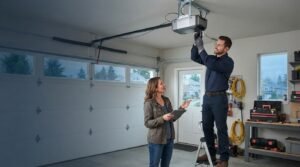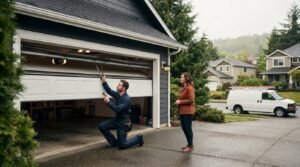
Your garage door isn’t trying to annoy you; it’s likely trying to protect you. While it feels like a breakdown when your garage door closes then opens back up, this behavior is usually a safety response triggered by the opener’s logic board. It’s a common frustration for homeowners across Washington, especially when security is on the line and you simply want your home to be locked and secure for the night.
We understand the stress of an intermittent mechanical failure, and we’re here to provide a clear path to a solution. This guide will help you identify exactly why your door won’t stay shut and provide the steps to fix it. You’ll learn how to troubleshoot misaligned sensors, adjust travel limit settings, and clear subtle mechanical blocks. We’ll also help you determine if the repair is a safe DIY project or if you need a professional to ensure your system complies with the latest safety standards, such as the 2026 WAC 308-408C-180 requirements for auto-reverse functionality. Whether you’re in Seattle or Spokane, getting your door to stay closed on the first try is our priority.
Key Takeaways
- Understand that when your garage door closes then opens back up, it’s usually the safety reversal system reacting to perceived resistance or a sensor obstruction.
- Learn how to recalibrate travel limits to stop “floor strike” reversals where the door hits the ground and immediately bounces back.
- Identify how common threshold debris like gravel, ice, or thick weather stripping can trigger a reversal before the door fully seals.
- Use our 5-step troubleshooting checklist to fix sensor alignment issues and determine if the problem is a safe DIY project.
- Recognize when hardware damage requires a professional to ensure your system meets the latest Washington state safety standards.
Understanding the Safety Reverse Mechanism
Since 1993, federal regulations have required all residential openers to include a safety reversal system. This mandate ensures that if a child, pet, or object is in the path of a moving door, the system will react instantly. When your garage door closes then opens back up, it isn’t necessarily broken; it’s responding to a perceived threat. This protective logic loop is triggered by either the photo-eye sensors or the motor’s internal force resistance settings. These systems are so critical that as of August 7, 2026, Washington home inspectors are specifically required under WAC 308-408C-180 to verify their function. While the “bounce back” feels like a mechanical failure, it’s actually the opener’s safety protocol working exactly as intended to prevent accidents.
It’s helpful to view this reversal as a diagnostic signal. The opener has detected resistance that it cannot safely overcome, leading it to return to the fully open position. This sensitivity is a core part of modern Garage Door Opener Safety Features, designed to prioritize safety over closure. Even if the obstruction is invisible to you, the system’s sensors or logic board have registered a conflict that requires a reversal.
The Role of Photo-Eye Safety Sensors
These sensors project an invisible infrared beam approximately six inches above the garage floor. If the beam is interrupted while the door is in motion, the door reverses. In the Pacific Northwest, weather plays a significant role in sensor performance. High humidity and heavy morning fog often cause moisture to collect on the glass lens, which can refract the light and trick the system into seeing an obstruction. Additionally, the damp, dark corners of garages in areas like Seattle are ideal for spiders. A single web or a small cluster of debris can block the signal. If your sensors are blinking instead of showing a solid green or amber light, a simple cleaning with a soft cloth often resolves the issue.
Identifying Logic Board and Remote Glitches
Electronic malfunctions can also mimic a safety reversal. A stuck button on a handheld remote or a wall-mounted console might send a double signal, telling the door to close and then immediately telling it to open again. We also encounter frequency interference from other household electronics that can create “ghost signals” or internal logic glitches. You can test this by removing the batteries from your remotes and operating the door only from the wall switch. If the garage door closes then opens back up only when the remotes are active, you likely have a faulty transmitter or a button that is physically jammed.
Adjusting Travel Limits and Force Settings
If your garage door closes then opens back up immediately after touching the ground, the issue is often a “floor strike.” This occurs when the opener’s travel limits are misconfigured. Think of travel limits as a digital or mechanical map that tells the motor exactly where the floor is located. If the opener believes the floor is two inches lower than it actually is, the door will strike the concrete, detect resistance, and trigger the safety reversal. This is a common reason why a garage door closes then opens back up even when the path appears completely clear. Small mechanical errors in the limit settings can lead to significant frustration for homeowners.
How to Calibrate the Down-Travel Limit
Most modern openers have adjustment screws or electronic buttons on the motor unit. You can typically find these labeled “Down Travel.” To fix a floor strike, follow the quarter-turn rule. Make very small adjustments; turning the screw too far can cause the door to stop short or slam into the track. After making an adjustment, test the door to see if it stops exactly where it should. You should also place a 2×4 wood block on the ground to confirm the door still reverses upon hitting a real object. This ensures you haven’t accidentally disabled the safety features while trying to fix the bounce-back. Precision is key here, as overshooting the limit can strain the entire system.
When Force Settings Need Professional Attention
Force settings determine how much pressure the motor applies before the system assumes it has hit an obstruction. While it might be tempting to increase the force to push through a problem, this is dangerous. The Federal Safety Standard for Garage Door Openers exists to prevent crushing injuries and ensures that doors remain responsive to obstacles. If your motor is making grinding noises or moving slowly, it’s a sign that internal components are struggling. Setting the force to the maximum level can damage the door panels, strain the cables, or even strip the opener’s internal gears. Professional technicians use specialized pressure gauges to ensure the door remains within safe operating limits. If small adjustments to the travel limits don’t stop the cycle where your garage door closes then opens back up, it’s time for a professional safety inspection to prevent long-term mechanical wear.
Mechanical Obstructions and Hardware Issues
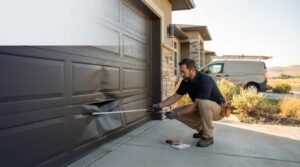
While logic settings and sensors are frequent culprits, physical resistance is just as likely to be the root cause. When your garage door encounters a physical barrier like a stray pebble, an ice dam, or even a build-up of gravel at the threshold, the motor detects a spike in resistance. This resistance tells the system that an object is trapped under the door. To prevent damage or injury, the system triggers a reversal. This physical interaction is a primary reason a garage door closes then opens back up, especially in Washington where winter ice and driveway debris are common. Even a new, thick piece of weather stripping can provide enough “push back” to trick the opener into reversing before the door fully seals.
The CPSC Final Rules for Garage Door Openers mandated these sensitive entrapment protections to ensure that any physical obstruction results in an immediate reversal. Beyond the threshold, internal friction within the door’s hardware can also trigger this response. Worn rollers or bent tracks create “friction points” where the door binds during its travel. If the motor has to work too hard to push the door past a bend in the track, it assumes it has hit an obstacle. Regular lubrication of the hinges, rollers, and springs is a vital maintenance step that reduces this friction and prevents false reversals.
Inspecting the Tracks and Rollers
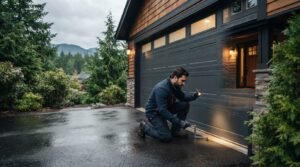
Vertical track alignment is essential for smooth operation. Even a slight tilt or a loose mounting bolt can cause the door to hitch as it descends. Look for “flat spots” on your rollers; these occur when the internal bearings seize, causing the roller to slide rather than roll. This sliding action creates significant drag. When cleaning your tracks, use a clean rag to wipe away dust and debris. You should never apply heavy grease inside the tracks. Grease attracts dirt and grime, which eventually hardens and creates the very obstructions you’re trying to avoid.
Spring Tension and Cable Balance
A properly balanced door should be easy to move by hand. You can perform a “Pull Test” by pulling the emergency release cord and moving the door to a halfway point. If the door crashes to the floor or flies upward, the springs are out of balance. A heavy door caused by weak or worn springs puts immense strain on the opener. This extra weight can lead the motor to believe it has hit an obstruction, causing the cycle where the garage door closes then opens back up. Keep in mind that torsion springs are under extreme tension. You should never attempt to adjust or replace torsion springs yourself, as this requires specialized tools and training to avoid serious injury.

Troubleshooting Checklist: 5 Steps to Try Now
When you’re standing in your driveway and your garage door closes then opens back up, you need a systematic approach to find the culprit. Most issues can be diagnosed within a few minutes if you follow a logical sequence. Start with the simplest external factors before moving to internal mechanical components. This methodical process helps you avoid unnecessary stress and pinpoint whether the fix is a quick adjustment or a job for a specialist.
- Step 1: Inspect the safety sensors. Check the base of the tracks for the small photo-eye units. Both should have a solid indicator light, usually green or amber, with no flickering.
- Step 2: Sweep the threshold. Clear the area directly under the door of all debris. Even a small accumulation of driveway gravel, packed snow, or an ice dam can trigger the safety reversal.
- Step 3: Examine your remotes. Check for stuck buttons on all handheld remotes and the wall-mounted station. A jammed button can send a continuous or conflicting signal to the motor.
- Step 4: Perform a visual track inspection. Look for loose mounting brackets or sections where the metal track has been crimped or bent. A hitch in the track’s curve can stop the rollers’ progress and force a reversal.
- Step 5: Test the door balance. If it’s safe to do so, pull the red emergency release cord and manually lift the door to chest level. If the door feels exceptionally heavy or slams down when released, the springs aren’t providing adequate lift.
The 30-Second Sensor Fix
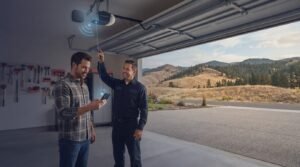
Sensor lenses are sensitive to dust, moisture, and even spiderwebs. Use a dry microfiber cloth to gently wipe the “eyes” of both sensors to ensure a clear path for the infrared beam. If the indicator light is flickering, the sensors are likely misaligned. Loosen the wing nut on the bracket and nudge the sensor until the light stays solid, then tighten it back down. Testing the door after this small adjustment often reveals that the reason your garage door closes then opens back up was simply a minor misalignment caused by a bumped trash can or a stray garden tool.
Identifying a Faulty Logic Board
If your sensors are clear and the tracks are straight, the “brain” of the opener might be failing. Erratic behavior, such as the door reversing at different heights each time, often points to a logic board glitch. Many modern openers use a “Light Bulb” diagnostic system. If the motor’s light bulbs flash ten times after a reversal, it typically confirms a sensor or wiring issue. However, if the behavior remains unpredictable and the opener is more than a decade old, it might be time to consider a full opener replacement rather than an expensive series of minor repairs. If your troubleshooting reveals a deeper mechanical issue, our team is available for emergency 24/7 garage door repair to secure your home immediately.
Professional Garage Door Repair in Washington State
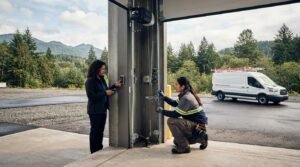
There is a point where DIY troubleshooting reaches its limit, especially when safety is at risk. While many homeowners can successfully align a sensor or clear a threshold, deeper mechanical failures require a specialist’s intervention. You should stop all repair attempts immediately if you notice frayed cables, visible gaps in your torsion springs, or if the door makes a loud, metallic screeching sound. These symptoms often indicate structural damage that could cause the door to fall unexpectedly. In Washington’s unique climate, the combination of coastal humidity and seasonal temperature shifts can accelerate hardware corrosion, making professional safety inspections a vital part of home maintenance.
When your garage door closes then opens back up despite basic adjustments, the issue may involve the internal drive system or a complex spring imbalance. Our technicians are trained to identify these subtle mechanical conflicts before they lead to a complete system failure. We prioritize professional, long-term results that restore the stability of your home’s primary entry point. By choosing a local partner, you ensure that the repair accounts for the specific housing styles and environmental factors found throughout the Pacific Northwest.
Why Choose Affordable Garage Door Repair & Sales?
Affordable Garage Door Repair & Sales LLC is a versatile expert in both residential and commercial systems. We maintain a professional, solution-oriented approach that focuses on providing peace of mind to our clients. We offer free on-site estimates for homeowners in Yakima, Pasco, and Ellensburg, ensuring you receive an accurate diagnosis without any initial financial commitment. Our team has extensive experience with all major opener brands, such as LiftMaster, and we ensure every repair meets the 2026 Washington state safety standards for auto-reverse functionality. We value being a dependable community anchor that prioritizes durability and value in every service call.
Our Service Areas Across Washington
A garage door that won’t stay shut is a significant security concern, particularly if the failure happens late at night. We provide 24/7 emergency repair services across the state to address these urgent needs. Our service network includes Seattle, Spokane, and Everett, as well as Tacoma, Auburn, Wenatchee, and Puyallup. Having regional offices allows us to offer rapid response times and expert local knowledge. If you are struggling with a system where your garage door closes then opens back up, Contact Affordable Garage Door Repair & Sales for a free estimate today to secure your home.
Restoring Security and Reliability to Your Home
Identifying the root cause of a reversal cycle involves checking sensor alignment, clearing physical obstructions, and verifying travel limit settings. Most of these steps provide a clear path to resolution for the average homeowner. Recognizing the boundary between a simple fix and a complex mechanical hazard is essential for your safety and the longevity of your hardware. When your garage door closes then opens back up, it’s a signal that your system’s safety logic is active and protecting your household. If basic troubleshooting doesn’t resolve the issue, professional calibration ensures your door meets modern safety standards while operating smoothly.
Affordable Garage Door Repair & Sales provides expert support across all of Washington State, including Seattle, Spokane, and Everett. We offer Free On-Site Estimates and 24/7 Emergency Service to keep your home secure at any hour. Get a Free On-Site Estimate for Your Garage Door Repair today and return to a door that stays closed on the first try. Our team is ready to provide the professional, dependable results you deserve.
Frequently Asked Questions
Why does my garage door open back up as soon as it hits the floor?
This behavior is typically caused by misconfigured travel limits, often referred to as a “floor strike.” Your opener’s internal map tells it to keep moving even after it has reached the concrete. When the motor detects the resistance of the floor, it assumes it has hit an obstruction and triggers the safety reversal. Small adjustments to the “down travel” settings on your motor unit in Everett or Seattle can usually resolve this issue.
Can I bypass the safety sensors to get my garage door to stay closed?
You cannot permanently bypass safety sensors because they are a federally mandated safety feature. While you can often override them temporarily by holding down the wall console button until the door fully closes, this is not a long-term solution. Bypassing these “eyes” creates a significant liability and safety risk for your family. If your sensors are failing in the damp Washington climate, it is better to have them professionally replaced or realigned.
How do I know if my garage door opener logic board is bad?
A failing logic board often causes unpredictable behavior, such as the door reversing at different heights or remotes losing their programming suddenly. If your opener ignores commands or the lights flash in patterns not related to sensor blockages, the “brain” of the unit may be damaged. In cities like Spokane or Tacoma, power surges during storms can often fry these sensitive electronic components, necessitating a professional opener replacement or a specialized board swap.
What does it mean when the lights on my garage door opener flash?
Flashing lights are a diagnostic tool used by the opener to communicate specific errors. For example, if the main overhead light flashes ten times after the garage door closes then opens back up, it almost always indicates a problem with the safety sensors. Other flash patterns might signal a logic board error or a motor overload. Checking your specific brand’s manual is the best way to decode these visual signals for a precise repair.
Is it dangerous to adjust the force settings on my garage door?
Yes, adjusting force settings carries significant risks if not done correctly. Increasing the force tells the motor to ignore resistance, which can lead to the door crushing objects or people before reversing. Excessive force also puts unnecessary strain on the cables and tracks, potentially leading to a more expensive off-track repair. Technicians in Auburn and Puyallup use specialized gauges to ensure the door remains within safe operating limits during every safety inspection.
How often should I lubricate my garage door tracks and rollers?
You should lubricate the moving parts of your door every six months to maintain smooth operation. Focus on the rollers, hinges, and springs using a high-quality silicone or lithium-based spray. Avoid putting grease or oil inside the tracks themselves; this attracts dust and debris that can eventually cause the door to bind. Consistent maintenance is especially important in Wenatchee and Yakima to prevent the hardware from seizing during extreme seasonal temperature shifts.
Why does my garage door reverse only when it’s cold or raining outside?
Cold weather causes metal components to contract and old lubricant to thicken, which increases the mechanical resistance the motor must overcome. In rainy areas like Seattle and Everett, moisture or fog can collect on the sensor lenses, refracting the infrared beam and triggering a false reversal. If your garage door closes then opens back up only during inclement weather, it’s a sign that your system needs professional calibration or fresh, weather-resistant lubrication to function correctly.
When should I call a professional for a garage door that won’t stay closed?
You should contact a professional if basic sensor cleaning and limit adjustments don’t solve the problem. If you hear grinding sounds, see frayed cables, or suspect a broken spring, these are high-tension issues that are dangerous for DIY attempts. Our team provides 24/7 emergency service across Washington to ensure your home remains secure. A professional safety inspection can identify hidden wear that might lead to a complete system failure or a hazardous collapse.