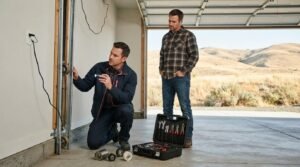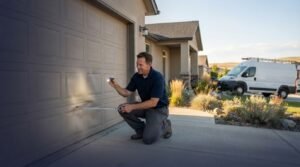
Did you know that over 1,600 people are treated for injuries every year specifically caused by garage door repair and maintenance? That sudden, loud bang you heard from the garage isn’t just a nuisance; it’s a warning about the serious dangers of DIY garage door spring repair. It’s natural to want to save money by tackling home projects yourself, especially when you’re worried about the cost of professional service. You want your home to be functional, and you want it fixed fast.
However, garage door springs are tightly wound mechanical components that store immense energy. Mishandling them can lead to catastrophic injury or expensive damage to your door and opener. This guide will help you understand the critical safety risks and financial pitfalls of attempting this fix on your own, and why professional intervention is essential for your peace of mind. We’ll examine the specific physics of spring tension, help you determine if your situation is an emergency, and show you how to find a reliable repair partner in Washington to get your door back on track safely.
Key Takeaways
- Understand why garage springs act as high-tension “loaded weapons” that must counterbalance doors weighing up to 400 pounds.
- Identify the specific dangers of DIY garage door spring repair, including the risk of severe lacerations and fractures from high-torque kickbacks.
- Learn how using incorrect retail parts can lead to hidden costs like motor failure and cable fraying.
- Compare the safety of professional-grade winding bars against the catastrophe of using makeshift household tools.
- Discover the value of high-cycle springs and expert installation for long-term peace of mind in Washington.
The Physics of Danger: Why Garage Springs Are ‘Loaded Weapons’
Garage doors are the largest moving objects in most homes. While they appear to glide effortlessly, they actually weigh between 150 and 400 pounds. The motor isn’t doing the heavy lifting; the springs are. A torsion spring is a high-tension steel coil that offsets the entire weight of the garage door. This mechanism is known as a torsion spring counterbalance system, and it works by storing immense mechanical energy within the coils as the door closes. It’s a delicate balance of physics that keeps your home safe and accessible.
When you attempt a repair, you’re dealing with hundreds of foot-pounds of torque. If a spring snaps or a tool slips, that energy is released in a fraction of a second. This violent release is one of the primary dangers of DIY garage door spring repair. It’s not just a mechanical failure; it’s a sudden explosion of steel that can shatter bones or throw heavy tools across the room. The physics involved are unforgiving. When a spring is wound, the steel molecules are stretched and held in place by set screws. Each turn of the spring increases the potential energy. If that energy is released unintentionally, the force is equivalent to a heavy sledgehammer strike. Professional technicians respect this power, using specific safety protocols that most weekend warriors simply don’t have access to.
Torsion vs. Extension Springs: Two Types of Risk
Torsion springs are mounted on a metal shaft above the door opening. To fix them, a technician must use specialized steel winding bars to apply or release tension. If a DIYer uses a screwdriver instead of a winding bar, the torque can cause the tool to kick back with lethal force. Extension springs, located along the side tracks, pose a different threat. Without a safety cable running through the center, a breaking extension spring becomes a high-velocity projectile capable of piercing through drywall or car windows. Both systems require a deep understanding of door balance to ensure the door doesn’t become lopsided or dangerous to operate.
The ‘Loud Bang’ and What It Means for Your Safety
Most homeowners first realize they have a problem when they hear a sound like a gunshot coming from the garage. This is the sound of the steel coil snapping under tension. If you hear this, don’t attempt to open the door. One of the most significant dangers of DIY garage door spring repair occurs when a homeowner pulls the red emergency release cord. Without the spring’s counterbalance, the full 400-pound weight of the door can come crashing down instantly. Additionally, springs are often installed in pairs. If one has snapped, the second is likely under extreme stress and could fail at any moment, creating a double hazard for anyone standing nearby.
The Reality of DIY Injuries: Common Accidents and Risks
Every year, an estimated 20,000 to 30,000 people are treated in emergency rooms for garage door accidents. While many of these involve simple pinch injuries, more than 1,600 of these incidents occur specifically during DIY repair and maintenance attempts. The dangers of DIY garage door spring repair are not exaggerated; they represent a significant medical risk to homeowners who lack specialized training. Because these springs are under constant, extreme tension, DASMA recommends that trained door systems technicians handle all spring adjustments and replacements to prevent life-altering injuries.
The most common injuries involve severe lacerations and “kickback” trauma. When a homeowner attempts to use a screwdriver or a standard wrench as a makeshift winding bar, the tool can easily slip. Under high torque, that tool becomes a high-speed projectile or a lever that can strike the user’s face with enough force to cause orbital fractures or broken teeth. Beyond tool-related trauma, there is a constant risk of falling. If a spring suddenly releases while you are standing on a ladder, the resulting shock or physical impact often leads to a secondary fall onto a concrete floor, resulting in head injuries or broken limbs.
Pinch points are another overlooked hazard. The coils of a torsion spring open and close as they are wound. If a finger or hand is anywhere near the spring during this process, it can be caught in the metal coils. The force is so great that it often leads to deep crushing injuries or even the loss of a finger. These accidents happen in a split second, long before a person has time to react or pull away.
Tool Malfunction: The Danger of ‘Making Do’
Most residential toolboxes don’t contain the equipment necessary to safely manage hundreds of pounds of tension. Standard wrenches and pliers are designed for static bolts, not for holding back the rotational force of a heavy-duty steel coil. When a spring reaches about 75% of its required tension, the torque is at its most volatile. This is the point where makeshift tools most frequently fail or slip. In the confined space of a garage, a slipping tool can bounce off walls and vehicles, creating a chaotic environment where you have nowhere to hide from flying metal.
The ‘Falling Door’ Hazard
A major risk during any spring repair is the sudden descent of the door itself. If the springs aren’t properly secured or balanced during the process, a 300-pound door can slam shut without warning. This can crush a limb or trap a person underneath. Many homeowners mistakenly believe the garage door opener will act as a safety brake. It won’t. The opener is designed to move a balanced door, not to hold the dead weight of a falling one. Choosing emergency garage door repair Everett services ensures that the door is professionally secured with locking pliers and winding bars throughout the process, keeping your family and your property out of harm’s way.
If you’re unsure about the state of your door, scheduling a professional safety inspection is the most responsible way to protect your home and avoid these physical risks.
Hidden Costs: How DIY Can Ruin Your Entire Garage System
While physical safety is the primary concern, the financial dangers of DIY garage door spring repair often extend far beyond the price of the parts themselves. Homeowners frequently view a spring as a standalone component. In reality, it’s the heart of a complex mechanical system where every part depends on the precision of the others. Attempting a quick fix without technical calibration often triggers a chain reaction of mechanical failures across the entire assembly.
The “Double Cost” trap is a common reality for many residents in Washington. This occurs when a homeowner buys retail parts and spends a weekend on the project, only to realize the door is still unbalanced. At that point, they must pay a professional to diagnose the error, remove the incorrect parts, and perform the job correctly. Big-box retailers typically stock a limited selection of “standard” springs. However, garage doors vary significantly in weight based on material, insulation, and glass content. Installing a spring that’s even slightly off in wire size or length creates an unbalanced door that won’t stay open or closed correctly.
Springs and cables operate as a single unit. DIYers often ignore frayed cables while replacing a spring, which leads to the cable snapping shortly after the new tension is applied. Additionally, an unbalanced door puts uneven pressure on the rollers. This can bend the vertical or horizontal tracks over time. Straightening or replacing these tracks is a specialized task that adds significantly to the final repair bill, often doubling the initial cost of a professional spring service.
Corrosion and the Washington Climate
In cities like Everett and Seattle, humidity is a constant factor for homeowners. Moisture often settles inside the coils of a torsion spring, causing “invisible” rust that weakens the metal from the inside out. Rusted springs are significantly more likely to shatter during a DIY winding attempt because the metal has become brittle. Professional technicians use high-grade lubricants specifically formulated to displace moisture and withstand PNW humidity, a step that most DIY guides overlook.
Opener Burnout: The $500 Mistake
Perhaps the most expensive hidden cost is the need for garage door opener replacement. If a DIY repair leaves the door even slightly “heavy,” the motor must strain every time it cycles. You might notice the motor humming louder or the door moving with a jerky motion. These are clear signs that the internal plastic gears are stripping under the weight. By the time the door stops moving entirely, the motor is often burnt out. Professional balancing ensures the door can be lifted with a single finger, which adds years of life to your opener and prevents this costly equipment failure.
Professional vs. DIY: A Safety and Tool Comparison
The fundamental difference between a professional repair and a home project often comes down to the equipment used. While a homeowner might reach for a large screwdriver or a pipe wrench, a technician uses tempered steel winding bars. These bars are specifically engineered to fit the winding cone of a torsion spring. They provide the necessary leverage to control the tension without slipping. Using makeshift tools is one of the most common dangers of DIY garage door spring repair, as it turns a manageable task into an unpredictable hazard. Precision tools ensure that the energy stored in the spring is handled with absolute control.
Professional inventory also differs significantly from what you find on a retail shelf. Most big-box stores carry “one-size-fits-most” springs designed for standard cycle counts. In contrast, professionals provide high-cycle springs. These are often rated for 25,000 to 50,000 cycles, whereas retail-grade springs often fail after 10,000. Additionally, a professional service includes a full safety inspection. A technician examines the rollers, hinges, and cables to ensure the entire system is healthy. They check for hairline fractures in the hinges or flat spots on rollers that a DIYer would likely overlook. This comprehensive approach prevents a single repair from turning into a series of rolling failures.
It is also a matter of legal and financial protection. Most major door manufacturers explicitly state that their warranties are only valid if the system is maintained by a trained professional. A DIY attempt often voids this protection, leaving you responsible for the full cost of any future structural failures. If you want to ensure your system remains under warranty while staying safe, you can schedule a professional spring repair today to get the job done right the first time.
The Training Factor: Expertise You Can’t Get from YouTube
Perfect door balance isn’t a matter of guesswork; it’s a calculation. Technicians use a metric called IPPT, or Inches Per Pound per Turn. This allows them to determine exactly how many quarter-turns a specific spring requires to lift the door’s exact weight. Without this knowledge, a DIYer may under-wind or over-wind the spring, leading to a door that is either too heavy to lift or too dangerous to close. A professional can also identify structural issues in the header or wall that might compromise the spring’s anchor point, completing a dangerous job in 30 minutes that might take an untrained person hours of high-risk labor.
Correct Sizing and Calibration
Professionals use a combination of wire gauge, coil diameter, and length to select the precise spring for your door. A common mistake in DIY projects is “over-winding” a spring that is slightly too small to force it to lift a heavy door. This places the steel under excessive stress, leading to premature failure or a violent snap. Proper calibration ensures the door remains level and stays in its tracks, preventing future off-track issues that could lead to a total system collapse. This level of precision is one of the many reasons why the dangers of DIY garage door spring repair outweigh any potential savings.
Safety First: Call Affordable Garage Door Repair & Sales
Professional intervention is the only way to eliminate the physical and financial risks associated with high-tension systems. Affordable Garage Door Repair & Sales specializes in broken spring repair and torsion springs, providing a stable solution when your door fails unexpectedly. Our team is committed to 24/7 emergency service across Washington state, ensuring you are never left vulnerable with a heavy, dangerous door. By choosing a professional, you avoid the dangers of DIY garage door spring repair and gain the security of a system that is precisely calibrated for longevity and safety.
We understand that a broken spring is more than a mechanical failure; it is a disruption to your family’s security and routine. Our technicians are highly trained to handle the volatile energy of garage springs with specialized winding tools, removing the possibility of tool kickback or structural damage. We offer a free on-site estimate to provide you with a clear, professional assessment without the guesswork or hidden costs of a weekend project. This transparent approach reinforces our identity as a dependable local partner focused on your peace of mind.
Serving Washington from Everett to Spokane
We operate as a versatile expert and a community anchor with regional hubs that allow for rapid response times. Our service area includes Everett, Spokane, Yakima, and the Greater Seattle area, extending to homeowners in Puyallup, Tacoma, Auburn, and Wenatchee. Local residents trust us for same-day emergency repairs because we understand the specific functional needs of Washington homes. Whether you are dealing with a door stuck closed in the humidity of the Sound or a snapped spring in the Inland Northwest, our team is equipped to provide a high-standard resolution quickly and efficiently.
What to Do While You Wait for a Technician
If you suspect a broken spring, your priority is to secure the area until a specialist arrives. Following these steps will help you avoid the dangers of DIY garage door spring repair and keep your household safe:
- Do not touch the door: Avoid any attempt to lift the door manually or pull the emergency release cord. Without the spring’s counterbalance, the door can slam shut with enough force to cause catastrophic injury.
- Unplug the opener: Disconnect the motor from its power source. This prevents anyone from accidentally pressing a remote or wall button, which could burn out the motor or cause the door to fall.
- Clear the workspace: Move vehicles, bikes, or storage items away from the garage door. Providing a clear, safe workspace allows the technician to begin the repair immediately upon arrival.
- Keep children and pets away: Ensure that the garage remains off-limits to everyone until the technician confirms that the system is balanced and the tension is secured.
Secure Your Property with Expert Repair Solutions
A garage door spring is more than a simple hardware component; it’s a high-tension mechanism that requires technical precision. Attempting a fix without specialized training or the correct equipment exposes you to the physical and financial dangers of DIY garage door spring repair. From avoiding severe injuries to preventing costly motor burnout, the benefits of professional intervention are clear. You deserve a garage door that operates smoothly and safely every time you press the button.
Our expert technicians in Everett, Spokane, and Yakima are available to provide the technical competence your home requires. We offer 24/7 emergency service to ensure your family remains secure, no matter when a failure occurs. Our team provides free on-site estimates to remove the stress and guesswork from the repair process. We are committed to delivering long-term results that protect your investment and your peace of mind.
Contact Affordable Garage Door Repair & Sales for a Free Estimate to restore your door’s functionality safely. Let our seasoned specialists handle the heavy lifting while you enjoy a reliable, high-standard result that keeps your home running exactly as it should.
Frequently Asked Questions
Can I replace just one garage door spring if only one is broken?
It is highly recommended to replace both springs at the same time. Because garage door springs are installed as a pair, they share the same age and cycle rating. When one spring snaps, the other has likely reached the same level of metal fatigue and will fail shortly after. Replacing both ensures the door remains perfectly balanced and saves you the cost of a second service call in the near future.
How much does a professional garage door spring repair cost in Washington?
The cost for professional repair depends on the type of spring and the specific weight of your door. Torsion springs and extension springs require different parts and labor times. Because every home has unique requirements, the most accurate way to determine your investment is through a free on-site estimate. This allows a technician to measure the wire gauge and door weight to provide a precise, transparent quote for your specific system.
How long do garage door springs typically last before they snap?
Standard residential garage door springs are typically rated for 10,000 cycles, which usually translates to 7 to 10 years of use. One cycle represents the door opening and closing once. If your household uses the garage frequently, you may reach this limit sooner. High-cycle springs are an available upgrade for those who want a longer lifespan, as they are often rated for 25,000 to 50,000 cycles.
Is it an emergency if my garage door spring breaks?
Yes, a broken spring is a safety emergency that requires immediate professional attention. The spring acts as the primary counterbalance for a door that weighs hundreds of pounds. When it fails, the door becomes a dead weight that can crash down without warning or trap your vehicle inside. Professional technicians offer 24/7 emergency services to secure your home and restore the door’s functionality safely and quickly.
What are the signs that my garage door spring is about to break?
Common warning signs include a door that feels unusually heavy or an opener motor that makes a straining noise. You might also notice visible gaps in the spring coils or hear loud popping sounds during operation. If the door opens only a few inches before stopping, the safety sensors or the opener may be reacting to a failing spring. Regular safety inspections can help identify these issues before a total failure occurs.
Can I still open my garage door manually if the spring is broken?
You should not attempt to open the door manually if a spring is broken. Without the counterbalance of the spring, you would be lifting the entire 150 to 400 pound weight of the door. This often leads to severe back injuries or causes the door to fall off its tracks. Attempting to force the door open is one of the primary dangers of DIY garage door spring repair and should be avoided.
Why is my garage door making a loud squeaking noise when it opens?
Loud squeaking is usually caused by metal-on-metal friction or lack of proper lubrication. In the damp Washington climate, surface rust can develop on the spring coils, causing them to bind as they wind and unwind. While professional-grade lubrication can often solve the problem, persistent noise may indicate that the spring is nearing the end of its lifespan. A technician can determine if the noise is a simple maintenance issue or a sign of fatigue.
Do I need special tools to wind a garage door torsion spring?
Yes, winding a torsion spring requires tempered steel winding bars that are specifically sized for your spring’s winding cone. Using makeshift tools like screwdrivers or pliers is a major factor in the dangers of DIY garage door spring repair. These improper tools can easily slip under the high torque of a wound spring, causing the tool to become a projectile. Professional tools provide the necessary leverage and grip to handle the tension safely.