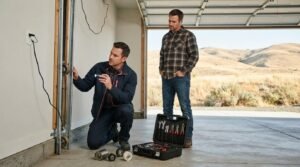
Buying a new garage door based on the word “standard” alone is one of the quickest ways to end up with a truck that won’t fit in your garage. While most residential homes utilize standard garage door sizes like 8×7 or 16×7, these common dimensions don’t always account for the height of a modern SUV or the specific headroom required for a smart opener. It’s a common worry for homeowners in Washington, where varying architectural styles in cities like Seattle or Spokane can make “standard” feel like a moving target.
You deserve a door that provides both curb appeal and functional peace of mind, but the technical difference between a rough opening and actual door dimensions often causes unnecessary stress. This guide is designed to remove that confusion. We’ll provide a clear breakdown of the most common residential dimensions for 2026 and explain when a 7-foot height is sufficient versus when an 8-foot door is a smarter investment for your vehicle.
By the end of this article, you’ll have the confidence to measure your own opening accurately. We’ll cover everything from single-car widths to double-car standards, ensuring your new installation is a perfect fit from day one. If you’re still feeling uncertain after reading, remember that professional on-site estimates can serve as your ultimate fail-safe for a precise fit.
Key Takeaways
- Identify the most common standard garage door sizes for single and double garages to ensure your home matches industry benchmarks for replacement and resale.
- Learn the precise method for measuring your rough opening to avoid common ordering errors that lead to functional issues during installation.
- Understand critical hardware requirements, including why you typically need between 3.75 and 5.5 inches of side room for proper track placement.
- Evaluate whether a standard 7-foot height provides enough clearance for modern SUVs and lifted trucks before finalizing your door selection.
- Discover how professional on-site estimates act as a fail-safe to guarantee a perfect fit for both standard and custom garage door openings.
Common Residential Garage Door Sizes: Single vs. Double
Understanding standard garage door sizes is the first step in a successful home renovation or new build. While every home is unique, the industry relies on specific dimensions to keep manufacturing efficient and costs manageable for the homeowner. Most people start by researching garage door basics to understand how these dimensions impact their daily routine, vehicle safety, and curb appeal.
Manufacturers typically categorize doors into “stock” and “semi-custom” groups. Stock sizes are the dimensions kept in local inventories for immediate installation. Semi-custom doors are often available in smaller increments, such as 2-inch steps, to accommodate older homes with non-standard openings. Choosing a stock size is usually the most cost-effective path, provided your home’s structural header supports it.
Single Garage Door Dimensions
For single-car bays, the 8×7 and 9×7 models are the most frequent choices. An 8-foot wide door is often found in older construction or detached garages meant for compact cars. However, the 9-foot width has become the modern baseline for new construction. It provides the necessary clearance for side-view mirrors on mid-sized trucks and SUVs without requiring a tight squeeze every morning.
Lately, 10-foot wide doors are gaining popularity for single-bay garages. They offer a luxury of space that prevents accidental scrapes and accommodates the wider profile of modern electric vehicles. While 7 feet remains the standard height, 8-foot tall doors are increasingly common. This extra foot of height is essential if you drive a vehicle with a roof rack or a lifted suspension.
Double Garage Door Dimensions
Two-car garages typically feature a 16-foot wide door. This size allows two standard vehicles to park side-by-side with enough room for passengers to exit comfortably. A 16×7 door is the most common residential configuration, though 16×8 is a frequent upgrade for families with taller vehicles. If your household includes two large SUVs or a full-sized pickup, an 18-foot wide door might be a better fit. This extra width reduces the risk of collisions when backing out in a hurry.
When deciding between one large double door or two separate single doors, you should consider both climate and aesthetics. Two single doors often offer better energy efficiency by keeping more conditioned air inside the garage when only one side is open. Conversely, a single double door provides a wider, unobstructed opening that makes it much easier to maneuver a single large vehicle into the center of the space.
How to Measure Your Garage Door Opening Correctly
Precision is the foundation of a successful installation. While you might have a general idea of standard garage door sizes, your specific garage opening determines which model will function safely. A common mistake is assuming that a standard house has perfectly square openings. In reality, settling foundations or warped framing can create slight irregularities that affect the seal and operation of your door. Measuring your space carefully ensures that the door hardware operates without friction and maintains a tight seal against the elements.
The most important term to understand is the “rough opening.” This measurement represents the space where the door and its hardware will eventually sit. According to industry standards for garage doors, these measurements must be exact to ensure the weather stripping creates a proper thermal barrier. Even a 1/2 inch discrepancy can leave gaps that let in moisture, pests, and cold air. Taking the time to verify your dimensions now prevents costly adjustments during the installation process.
The 4-Point Measurement Checklist
To get a complete picture of your space, you need four distinct measurements. First, measure the width between the side jambs at the top, middle, and bottom. Second, measure the height from the floor to the header. Third, verify the side room, which is the clearance for the vertical tracks. Finally, calculate the headroom between the header and the ceiling to ensure there’s enough space for the door to curve and for the opener to be mounted securely. Use the smallest width and height measurements if your frame isn’t perfectly square.
Common Measurement Pitfalls to Avoid
A rough opening is the finished interior dimensions of the door frame. Many homeowners make the error of measuring their existing door panels instead. This is unreliable because panels often overlap the frame or have specific trim that hides the true opening size. You should also inspect the area for internal obstructions. Check for water pipes, electrical conduits, or low-hanging lights that might block the tracks. Ensuring the side jambs are plumb and the header is level will prevent unnecessary wear on your new springs and cables over time.
If you’re feeling uncertain about these technical details, help is available. You can schedule a free on-site estimate to have an expert confirm your measurements and ensure your new door fits perfectly.
Critical Clearances: Headroom, Side Room, and Backroom
While selecting standard garage door sizes is a vital step in your home improvement project, the door itself only represents one part of the mechanical puzzle. You must also account for the structural clearances required to house the tracks, springs, and motor. These “invisible” dimensions—headroom, side room, and backroom—determine whether a specific door model can function safely within your existing architecture. Neglecting these measurements can lead to hardware interference, noisy operation, or an inability to install a modern opener system.
The structural integrity of garage doors depends heavily on proper track alignment and mounting. If the garage frame lacks the necessary clearance, the door may not distribute its weight evenly, leading to premature wear on the rollers and cables. In Washington homes where garage space is often shared with storage or HVAC equipment, understanding these clearance requirements prevents costly structural modifications after the door has already been purchased.
Headroom Requirements for Openers
Headroom is the vertical distance between the top of the door opening and the lowest point of the ceiling or any overhead obstructions. For a standard torsion spring system, you generally need 12 inches of clearance. Extension spring systems are slightly more forgiving, often requiring only 10 inches. However, if you are planning a garage door opener replacement with a modern smart unit, you should plan for an additional 3 inches of space. This extra room accommodates the opener rail and ensures the motor has enough ventilation to operate efficiently.
If your garage has less than 10 inches of headroom, you don’t necessarily need to remodel. Low-headroom hardware kits, which utilize a dual-track system, allow the door to navigate the curve at a much lower profile. This is a common solution for older residential garages where ceiling height was not a priority during original construction.
Side Room and Track Mounting
Side room refers to the horizontal space on either side of the rough opening. Most residential tracks require between 3.75 and 5.5 inches of flat, unobstructed mounting surface. This area must be clear of electrical conduits, light switches, or shelving. Without sufficient side room, the vertical tracks cannot be bolted securely to the wall jambs, which compromises the stability of the entire system. Commercial doors or heavy-duty wind-rated doors may require up to 9 inches of side room to accommodate larger hardware and reinforced tracks.
Backroom is the final piece of the clearance puzzle, measuring the depth of the garage from the header to the rear wall. For a standard 7-foot tall door, you need at least 8 feet of backroom for the door to retract fully. If you are installing an automatic opener, that requirement extends to approximately 10 to 11 feet to house the rail and motor assembly. Always verify that your backroom is clear of hanging lights or attic access panels before finalizing your standard garage door sizes selection.

Choosing the Right Size for Your Vehicle and Lifestyle
Selecting from standard garage door sizes involves more than matching the existing hole in your wall. You must evaluate how your garage functions as a gateway for your daily life. Modern vehicles have grown significantly in both height and width over the last decade. A door that served a sedan perfectly twenty years ago might present a constant risk of damage to a 2026 full-sized SUV or a modern electric truck.
Future-proofing your home is a vital part of this decision. Even if you drive a compact car today, your next vehicle might be a larger SUV or a van. Investing in a larger standard size now prevents the need for an expensive structural header remodel later. It’s about creating a space that adapts to your changing needs without requiring a total overhaul of your home’s facade.
Standard Sizes for SUVs and Large Trucks
While 7-foot doors remain the most common stock option, they frequently fail to provide adequate clearance for modern utility vehicles. For truck owners in Washington, an 8-foot height is becoming the new standard. This extra foot of clearance is essential if you use a roof rack, cargo carrier, or have a lifted suspension. It provides the peace of mind that you won’t clip your gear on the header when pulling in after a weekend trip.
Width is just as critical as height. A standard 8-foot wide door leaves very little margin for error for modern trucks equipped with wide towing mirrors or sensitive blind-spot sensors. If your driveway requires a sharp turn into the garage, opting for a 9-foot or 10-foot wide door can save you from costly mirror repairs and paint scrapes over time.
Multi-Purpose Garage Considerations
Your garage’s role beyond parking also dictates the ideal door size. If you utilize the space as a workshop, home gym, or storage for outdoor gear, a wider door improves accessibility for moving large equipment. However, there is a trade-off with energy efficiency. Smaller doors are easier to insulate, which helps keep a heated workshop comfortable during cold Everett or Spokane winters. Balancing these functional needs requires a strategic approach to your new garage door installation in Washington.
Consulting with an expert can help you weigh the benefits of different dimensions against your specific lifestyle requirements. To ensure you choose a door that fits both your vehicle and your long-term plans, you can schedule a free on-site estimate to review all available configurations in person.
Professional Installation and Custom Size Solutions
While standard garage door sizes cover the vast majority of residential needs, they aren’t a universal solution for every property. Many older homes in Washington feature custom framing that predates modern manufacturing benchmarks. If you’re dealing with a non-standard opening, forcing a stock door to fit can compromise both your home’s security and its energy efficiency. Custom-sized doors are a necessary alternative when your architecture demands a precise, tailored fit that off-the-shelf models cannot provide.
Structural Modifications for New Sizes
Widening an existing garage opening is a significant structural undertaking. It’s not as simple as cutting away more of the wall. The most critical component is the door header, which supports the weight of the wall above the garage. If you decide to move from two single 8-foot doors to one double 16-foot door, the header must be replaced with a single, reinforced beam to maintain the home’s structural integrity. This is especially vital in regions like Seattle, Tacoma, and Spokane, where homes must meet specific building codes for durability and load-bearing capacity.
Washington’s diverse climate also means that large doors must adhere to local wind load requirements. A wider door has more surface area, making it more susceptible to high-pressure wind events. Professional installers ensure that even when you deviate from standard garage door sizes, the door remains reinforced and properly weighted for its specific dimensions. This level of technical oversight prevents the door from buckling or coming off its tracks during a storm.
The Value of Expert Consultation
Affordable Garage Door Repair & Sales LLC specializes in navigating these sizing and structural challenges. Our team understands the nuances of local Washington building requirements, ensuring that your installation is both safe and compliant. We offer a variety of styles in standard sizes, from budget-friendly steel to glass impact models, but our real strength lies in providing a fail-safe for homeowners. By conducting professional measurements, we eliminate the risk of ordering the wrong size, which could otherwise void your warranty or lead to safety hazards.
Your next step toward a reliable, high-quality garage door is simple. Rather than guessing with a tape measure, you can schedule a free on-site estimate. This allows a seasoned specialist to evaluate your header, check your clearances, and provide a comprehensive solution tailored to your home’s unique footprint. For homeowners across Everett, Yakima, and beyond, this consultation is the most dependable way to guarantee a perfect result.
Secure Your Investment with a Precision Fit
Selecting the right door is a decision that impacts your home’s safety and curb appeal for years to come. You now understand how standard garage door sizes like 9×7 or 16×7 serve as starting points, but vehicle height and side room clearances are what truly define a successful fit. Precision matters because even a small measurement error can lead to hardware friction or poor insulation performance. It’s about ensuring your SUV fits comfortably without the risk of expensive scrapes.
Affordable Garage Door Repair & Sales LLC is committed to providing durable results for homeowners in Everett, Spokane, and throughout Washington. We offer expert installation for both residential and commercial standards, backed by 24/7 emergency service for your peace of mind. Our team handles everything from broken spring repairs to complex smart upgrades with technical competence. Don’t leave your home’s functionality to chance.
To ensure your new installation is a perfect match for your vehicle and lifestyle, Get a Free On-Site Estimate for Your New Garage Door today. We take the stress out of the measuring process. You can move forward with confidence knowing your new door will be as reliable and functional as it is beautiful.
Frequently Asked Questions
What is the most common size for a single garage door?
The most common standard garage door sizes for a single-car bay are 8 feet by 7 feet and 9 feet by 7 feet. While 8-foot widths were once the baseline, 9-foot doors are now the preferred choice for new construction in cities like Everett and Seattle. This extra width provides better clearance for modern vehicle mirrors. If you have a larger vehicle, you might even consider a 10-foot wide option to prevent accidental scrapes.
Will a 7-foot garage door fit a full-size SUV?
Most full-size SUVs will fit through a 7-foot tall garage door, but the clearance is often quite narrow. If your vehicle features a roof rack, cargo carrier, or a lifted suspension, a 7-foot height may be insufficient. Homeowners in Spokane and Yakima often upgrade to an 8-foot tall door to accommodate these modifications safely. It’s best to measure your vehicle’s highest point while it’s parked on a level surface before ordering your new door.
How much headroom do I need for a garage door opener?
Standard torsion spring systems typically require 12 inches of headroom, while extension spring models can operate with 10 inches. If you’re planning a smart opener upgrade, you should account for an additional 3 inches of clearance for the motor and rail assembly. For garages in Tacoma or Auburn with limited ceiling height, low-headroom hardware kits are available. These specialized tracks allow the door to function correctly even in tight spaces with as little as 6 inches of room.
Can I install a 16-foot door in an opening that is slightly smaller?
You cannot install a 16-foot door in an opening that is even slightly smaller than 16 feet. The rough opening must match the door size exactly to ensure the tracks and weather stripping function as intended. If your opening is non-standard, you’ll need to either modify the structural header or order a custom-sized door. Our specialists in Pasco and Ellensburg can evaluate your frame during a free on-site estimate to determine the most cost-effective solution for your home.
What is the standard height for a garage door?
The standard height for a residential garage door is 7 feet. However, 8-foot tall doors have become a frequent choice for modern homes to accommodate taller trucks and utility vehicles. Choosing between these standard garage door sizes depends on your specific clearance needs and the architectural style of your home. In many Washington neighborhoods, builders are increasingly installing 8-foot headers to provide homeowners with more versatility for future vehicle purchases and improved resale value.
Is it cheaper to get a standard size garage door than a custom one?
Standard size garage doors are generally more affordable than custom models because they are mass-produced and kept in local inventory. Choosing a stock size allows for faster installation and lower material costs. Custom doors require specialized manufacturing and longer lead times, which increases the total investment. If your opening is slightly off-standard, a professional installer can often adjust the framing to accommodate a stock size, saving you the expense of a fully custom order while maintaining structural integrity.
How do I know if I need a 10-foot wide garage door?
You likely need a 10-foot wide door if you drive a full-sized pickup truck or a wide electric vehicle. This width provides a significant safety margin compared to the more common 9-foot standard. It’s also an excellent choice for garages that require a sharp turn from the driveway, as it reduces the risk of clipping your mirrors. Homeowners in Wenatchee and Puyallup who use their garage for frequent gear storage or workshop access also find that the extra foot of width improves daily accessibility.
Does a new garage door include the tracks and hardware?
A new garage door installation typically includes the door panels, vertical and horizontal tracks, rollers, hinges, and all necessary mounting hardware. It also includes new springs, whether they are torsion or extension models. However, the garage door opener is usually sold separately unless you are purchasing a complete installation package. At Affordable Garage Door Repair & Sales LLC, we ensure every component is properly matched and professionally installed to guarantee the long-term safety and efficiency of your new system.